
OCT
Cadaver lab transforms learning for LCCC paramedic students
Hands-on training with human anatomy better prepares future emergency responders
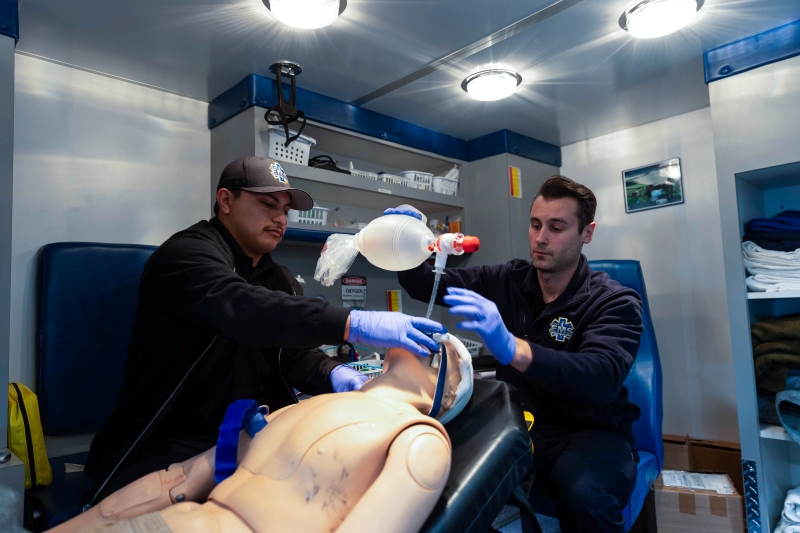
For the emergency medical providers who are first to arrive when someone’s life hangs in the balance, the work is about more than skill — it’s about responsibility. Every decision, every movement, can shape the outcome for patients, families and communities.
That reality hit home for Laramie County Community College paramedic student Kyle Pope when he performed a surgical cricothyrotomy — cutting into the airway of a person who can’t breathe — on a human cadaver. The rare opportunity made the difference between learning about saving lives and truly understanding what it means to do it.
The experience, Kyle said, drove home the gravity of the work ahead of him.
“When you realize this was a real person who donated their body so we could learn to help others, it changes how you think about the job,” Kyle said. “There’s a seriousness to it that you can’t get from a manikin.”
That sense of realism and responsibility is exactly what LCCC’s Emergency Medical Services Program leaders hoped to bring when they introduced human cadavers into the curriculum this summer. The decision came from recognizing how difficult it has become for students to access operating rooms for airway procedures. The experience gives students a tangible understanding of anatomy and emergency procedures that manikins and simulations can’t match — a vital step in preparing them to respond confidently in critical moments.
“Having cadavers available allows students to make that intermediate step between plastic training heads and working with real patients,” said Larry Jones, LCCC’s Emergency Medical Services program director.
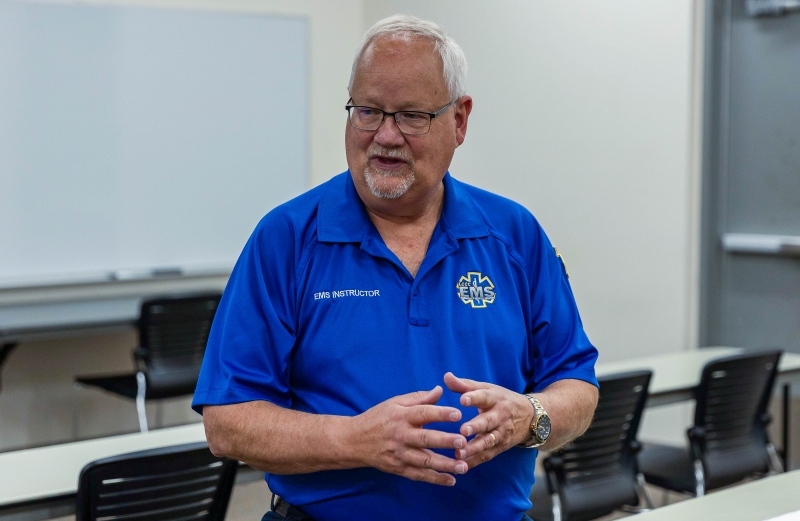
The program uses LCCC’s on-campus cadaver lab, which Scott Logan, LCCC’s clinical coordinator for EMS, and Jones worked together to bring into service. The college now partners with Science Care, the world’s largest non-transplant anatomical donation organization, which ships cadaveric specimens from its regional hub in Aurora, Colorado. The partnership ensures the specimens are high-quality, ethically sourced and properly preserved for safe use in education.
“We worked with Science Care to bring the cadaver here and prepared the lab to meet all safety and storage requirements,” Scott said. “Our medical director, a retired trauma surgeon, joined the students to walk them through procedures like intubation and interosseous needle insertion. It’s as close to a real clinical environment as you can get without working on a living patient.”
For the students, the opportunity to work with a real human body brought an entirely new dimension to their learning.
“With a manikin, everything’s static — the tongue’s always in the same place,” Larry said. “A real body reacts. Students can feel the texture, the weight and the resistance, which gives them a much truer understanding of what they’ll face in the field.”
Students also performed surgical procedures such as cricothyrotomy and chest decompression, gaining a sense of the body’s structure and the subtle differences that matter in real emergencies. Afterward, they took part in a guided anatomy review that tied what they’d seen and felt to their coursework.
“They could see where the ribs and arteries sit, how the heart connects to the lungs, and why each movement they make in an emergency matters,” Scott said. “It connects the academic to the practical.”
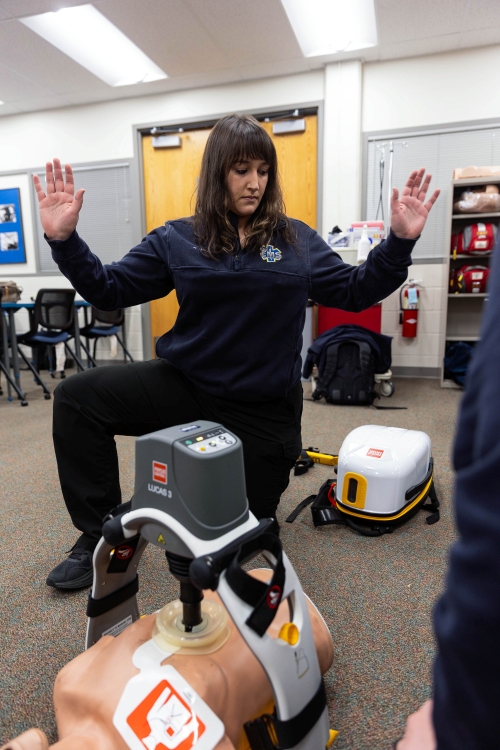
For Kyle and fellow paramedic student Matt Zdanek, the experience made their training more concrete and more serious.
“As paramedics, there are skills we might never use in the field because they’re high-risk, low-frequency calls,” Kyle said. “Getting to do those on a cadaver gives you confidence and understanding that a simulation never can.”
Matt said the experience helped him locate and identify critical landmarks that can be hard to visualize without hands-on practice.
“Finding those landmarks and understanding how they feel on a real body helps you trust your instincts,” he said.
After seeing the impact on students, EMS faculty plan to make cadaver sessions a permanent part of the program and expand opportunities for other disciplines. Scott said they’re exploring ways for respiratory therapy and other Health Sciences programs to share in the experience.
“It’s worth every penny,” Larry said. “When students leave here, they’re better prepared to perform under pressure, and that means better care for patients in our communities.”