
SEP
Here for the long haul
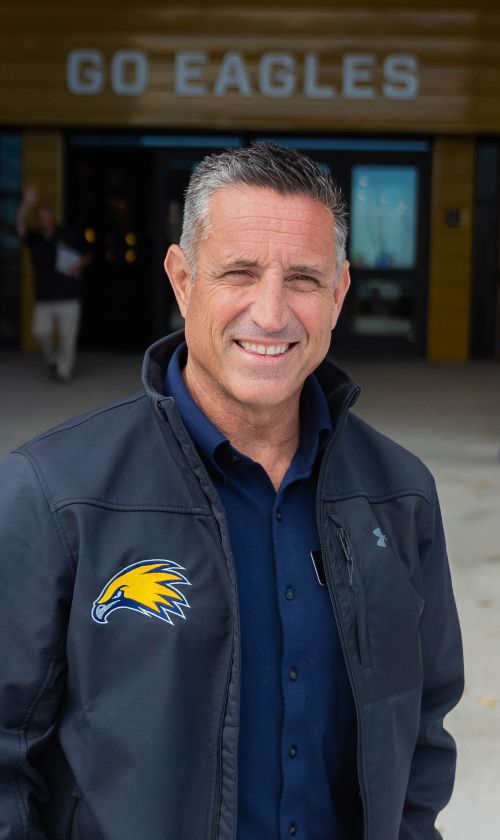 Gary Addington spent 28 years at Otero College in La Junta, Colorado — his entire
career in higher education. But even with all those years at a junior college, he’s
not entertaining any ideas of moving on from that level of education and athletics.
That’s why he’s planning a long tenure at Laramie County Community College as its
new athletic director, a job he began Sept. 8.
Gary Addington spent 28 years at Otero College in La Junta, Colorado — his entire
career in higher education. But even with all those years at a junior college, he’s
not entertaining any ideas of moving on from that level of education and athletics.
That’s why he’s planning a long tenure at Laramie County Community College as its
new athletic director, a job he began Sept. 8.
That conviction comes from a belief that community colleges are about much more than athletics. They are about transformation, helping young people arrive at goals, face challenges and uncertainties, and leave as responsible people ready to succeed in life.
“It’s not just about developing good basketball players,” Gary said. “It’s about developing people, making them adults that will have fulfilling lives, who are positive community members. You just can't be good athletically — it's the whole picture. You’ve got to be great in the classroom; you’ve got to be great on the court or on the field; you’ve got to be great in the community. It’s about being well-rounded.”
More than competition
Athletics is central to the student experience at a college like LCCC. But for Gary, competition is only part of the picture. A win-loss record matters, yet it is not the defining outcome. What he hopes to build is an environment where academic achievement, responsibility and persistence carry as much weight as performance on the field or court.
“If you don’t take care of the academics, athletics doesn’t matter,” Gary said. “Because if they don’t have the academics, they’re not going to have the opportunities in front of them.”
That perspective is shaped by his time not only as athletic director, but also as dean of student affairs at Otero. Overseeing 20 programs and more than 500 student-athletes gave him a broad view of how academics and athletics intersect, and why balance is critical.
Connection at the heart
A large part of Gary’s philosophy comes down to connection. At the junior-college
level, it is possible for leaders to truly know their students; to see them in the
classroom, at practice and in the hallways, and to be present in moments of both triumph
and struggle.
“I like being able to connect with the students, and at this level, you can really do that,” Gary said. “It’s just my personality, but I also think it comes from experience. I’ve seen what they go through, and I know how much difference it makes when you’ve got people who care about you.”
Connection is not just about cheering from the sidelines. For Gary, it’s about mentoring, advising and sometimes having tough conversations. He wants to help students learn that dedication pays off and shortcuts rarely do.
“If you put in the work, you get the reward,” Gary said. “That’s the thing I really try to get across. You can’t cut corners in life, because it’s going to catch up to you.”
A well-rounded path
Gary played baseball at Otero from 1989 to 1991 while earning his associate degree. From there, he went on to earn a bachelor’s degree in mathematics from Colorado State University and a master’s degree in health and physical education from Adams State University.
Along the way, he added teaching and administrative experience to his résumé, working as an adjunct mathematics instructor and serving in advising and financial aid. Coaching was also part of his story, giving him the on-the-ground understanding of how to motivate and guide student-athletes.
All of those roles — athlete, coach, educator, administrator — contributed to a view of athletics that is holistic. Gary has seen the challenges from every angle, and he understands how all the pieces connect.
“I think that gives me a well-rounded perspective. I’ve been in their shoes, and I know what it takes.”
That perspective is also tied to place. La Junta isn’t just where Gary worked for nearly three decades — it’s his hometown. Attending Otero College as a student-athlete meant competing for the community that raised him, and staying on to work there after graduate school gave him the chance to give back in a lasting way.
His path into coaching at Otero wasn’t something he fully expected.
“I got a phone call from Otero that said, ‘Hey, we hear you’re into coaching a little bit, and we’d love you to come down and start the women’s softball program,’” Gary said. “I thought, ‘Wow, what a great opportunity.’ My wife said, ‘Yeah, and then we’ll leave, go to a bigger town,’ but then I went into baseball the next year and had a couple good years, and thought, ‘I’m not leaving.’ And we didn’t for almost 30 years.”
Success as a young coach gave him confidence, but it was the relationships that convinced him to stay. Gary saw how students grew through the ups and downs of competition, and how his influence as a coach could ripple far beyond the playing field.
“You can stay and work on building a dynasty, or you can advance your career and move up, whatever your goals are,” he said. “We don’t want to hinder our coaches. We want to give them good experiences, and if they choose down the line to move up, we’ve prepped them to do that.”
Those experiences early in his career also gave him a front-row view of how the lessons in discipline, accountability and resilience shaped students’ lives long after they left Otero.
“One kid I cut for breaking a team rule called me seven years later and said that was one of the best things that happened to him,” Gary said. “It didn’t resonate right away, but as time went on, he realized it was probably the best thing for him.”
That perspective has also been shaped by his own family’s deep involvement in athletics. Gary and his wife, Kelly, raised three children who all played sports growing up, with two competing at both the junior college and university levels. Kelly herself played and coached college athletics, making their household what Gary calls a “sports family through and through.”
“They helped me with the student-athlete perspective and the relationships they had with coaches both at the university and JUCO levels, from the inside, if you will,” he said. “I know for me at least, I went about business a little differently and had a different perspective on how I went about daily business as an administrator and as a coach after I had kids who were playing competitively.”
Opportunity in Cheyenne
Now at LCCC, Gary sees a chance to apply that experience in a new setting. Early impressions of the Blue Federal Credit Union Recreation and Athletics Complex and other facilities gave him confidence that the college is committed to athletics. But more important than buildings are the people who make up the community.
“I think the facilities are great. And I think the people that are here are passionate about it,” Gary said. “So we’ve got a lot of opportunities to build on.”
Those opportunities extend to recruiting. With strong resources and support, Gary sees the potential to attract student-athletes who are not only talented but also eager to grow academically and personally. His vision is for LCCC to be a place where athletes want to come not just because of the competition, but because they know it will prepare them for life after college.
“Facilities are nice, but it really comes down to people,” he said. “That’s what makes a program go: the coaches, the staff, the people who believe in what we’re doing.”
Listening first
Even with clear principles guiding his leadership, Gary said he is taking the early months at LCCC to listen and learn. He recognizes that every college has its own culture, and building success means understanding what is already working before making changes.
“I don’t want to come in and just change everything,” Gary said. “I want to see what’s working and then find out how we can make things better.”
That patience reflects his belief in collaboration, looking forward to hearing from coaches, faculty, staff and, most importantly, students as he shapes the future of the Golden Eagles.
Looking forward
For Gary, the role at LCCC is not a short stop. After nearly three decades at Otero, he is ready to make LCCC his professional home for years to come. His family is excited to be part of the Cheyenne community, and he is eager to leave a lasting mark on the program.
“I want to be here for a long time,” Gary said. “I think this is a great fit for me. And I think we can really do some good things here.”
That long-term commitment ties back to the same reasons he has always stayed at the community college level. It’s where the work is personal, where the focus is on building not just athletes but responsible adults, and where connection makes the difference.