
Car Trouble to Career Path
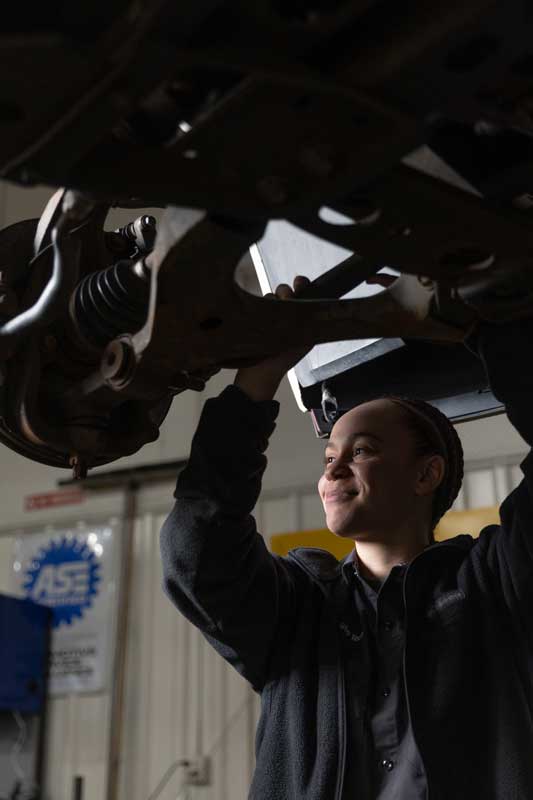
For Jaya Brown, it was the alternator on a 2005 Ford.
Jaya, who graduated from Cheyenne South High School in 2021, was still in high school when the car started giving her trouble. At first it wouldn’t start. A jump worked for a while, but it began dying while she was driving. The battery was new, so Jaya started doing a little research. Soon she had a theory.
“I figured it was the alternator,” Jaya said.
Instead of taking the car to a shop, she decided to try fixing it herself. What started as a necessity quickly turned into something else.
“It was just way fun and way cool,” Jaya said.
That experience opened the door to an idea she hadn’t seriously considered before: working on cars for a living.
Jaya moved to Cheyenne when she was 2 years old and grew up here. After graduating
from South High School, she briefly attended the
University of Wyoming, studying psychology. But the experience didn’t feel right.
Large lecture halls with more than 100 students felt impersonal, and the traditional classroom environment didn’t hold her interest.
“I only did a semester,” Jaya said.
Eventually, Jaya stepped back, worked for a while and thought about what she really wanted to do. She kept hearing about Laramie County Community College and its Automotive Technology Program. Since she already enjoyed fixing things, the idea started to make sense.
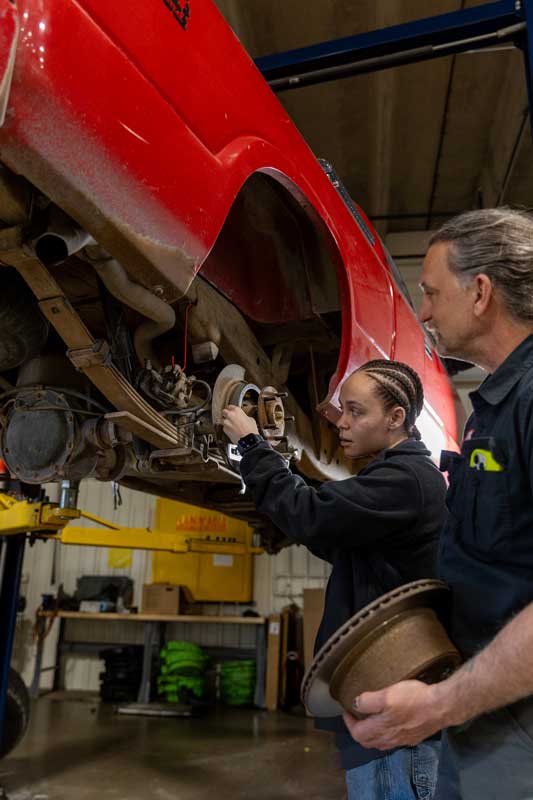
Today, she is part of LCCC’s Auto Tech program in the college’s Trades & Technical Studies Pathway. In the automotive program, she said, classes are usually closer to 20 or 30 students, which, in contrast to the university lecture hall, is a different experience.
“It makes it easier to ask questions and talk to the instructor,” she said.
The program focuses on practical skills students need in the industry, including engines, fuel and ignition systems, brakes, transmissions, electronic diagnostics and other core automotive systems. Courses also prepare students for Automotive Service Excellence certification exams, the national credential widely recognized in the field.
Demand for skilled technicians remains strong across the country. According to the U.S. Bureau of Labor Statistics, automotive service technicians and mechanics earned a median annual wage of about $49,670 in 2024, with some experienced workers earning more than $80,000. The agency also projects about 70,000 job openings each year over the next decade, driven largely by retirements and the need to replace workers leaving the field.
That demand is one reason programs like LCCC’s automotive technology program continue to attract students who want a hands-on career.
Brad Whitman, ASE Master Automobile Technician and automotive instructor at LCCC, said the program is designed to prepare students for real work in the shop.
“Our students learn advanced skills by working on vehicles, diagnosing problems and then repairing them,” he said. “That hands-on experience is what prepares them for jobs when they leave us.”
For Jaya, the program is still new. She started her first semester in August and is
continuing to build her knowledge one system at
a time.
Engines were intimidating at first, she said, but learning how all the parts work together has changed that.
“When you first come in, you kind of dread it,” Jaya said. “But there are so many little things that go into it. I just want to learn a whole lot about everything.”